
Generate reality.
AI fluent in physics. Ask for the outcome. It designs the part and proves it, in milliseconds.
SEC. 02 · THE PROBLEM
Simulation got fast. Design is still by hand.
A design space holds millions of candidate geometries. A classical solver clears a handful per day.
So engineers iterate by intuition and wait hours per run. The loop, not the physics, sets the schedule.
Fast surrogates get gamed. An optimizer exploits model error and ships it as a design.
The failures surface in hardware, at the prototype stage, where they cost the most.
SEC. 03 · THE MODEL
One operator. Any geometry.
Daedalus reads the surface of a machine as tokens and returns the full field. Not a mesh pipeline per part. Not a retrain per product family. One operator that generalizes across geometry it has never seen.
Because it is differentiable, the same weights that predict a field also design one. The optimizer pushes gradients through the frozen operator into the shape itself.
SEC. 04 · THE LOOP
A loop that cannot lie.
Optimizers attack their own surrogate. Ours is audited: the classical solver sits inside the loop and recomputes every result the model proposes. The stamp is earned, not predicted.
The operator predicts the full field on the current geometry. Milliseconds, not hours, so the loop can afford thousands of candidates.
SEC. 05 · BENCHMARKS
Against the incumbents.
EVERY DAEDALUS NUMBER IS RE-SOLVED BY A CLASSICAL SOLVER BEFORE IT IS PUBLISHED.
INCUMBENT FIGURES REFLECT TYPICAL COMMERCIAL-SOLVER WORKFLOWS ON EQUIVALENT SCENES; SURROGATE DEGRADATION FROM PUBLISHED BASELINES. METHODS NOTES SHIP WITH EACH RELEASE ON THE RESEARCH PAGE.
SEC. 06 · TRAJECTORY
One model. Physics as a prompt.
Every physics Daedalus absorbs uses the same boundary tokens, the same assembly mechanism, the same verification discipline. Sound today. Vibration, heat, and electromagnetics next. The end state is a machine designed whole: forty parts, coupled physics, one verified loop.
SEC. 07 · THE STUDIO
Nooterra Studio. Open to everyone.
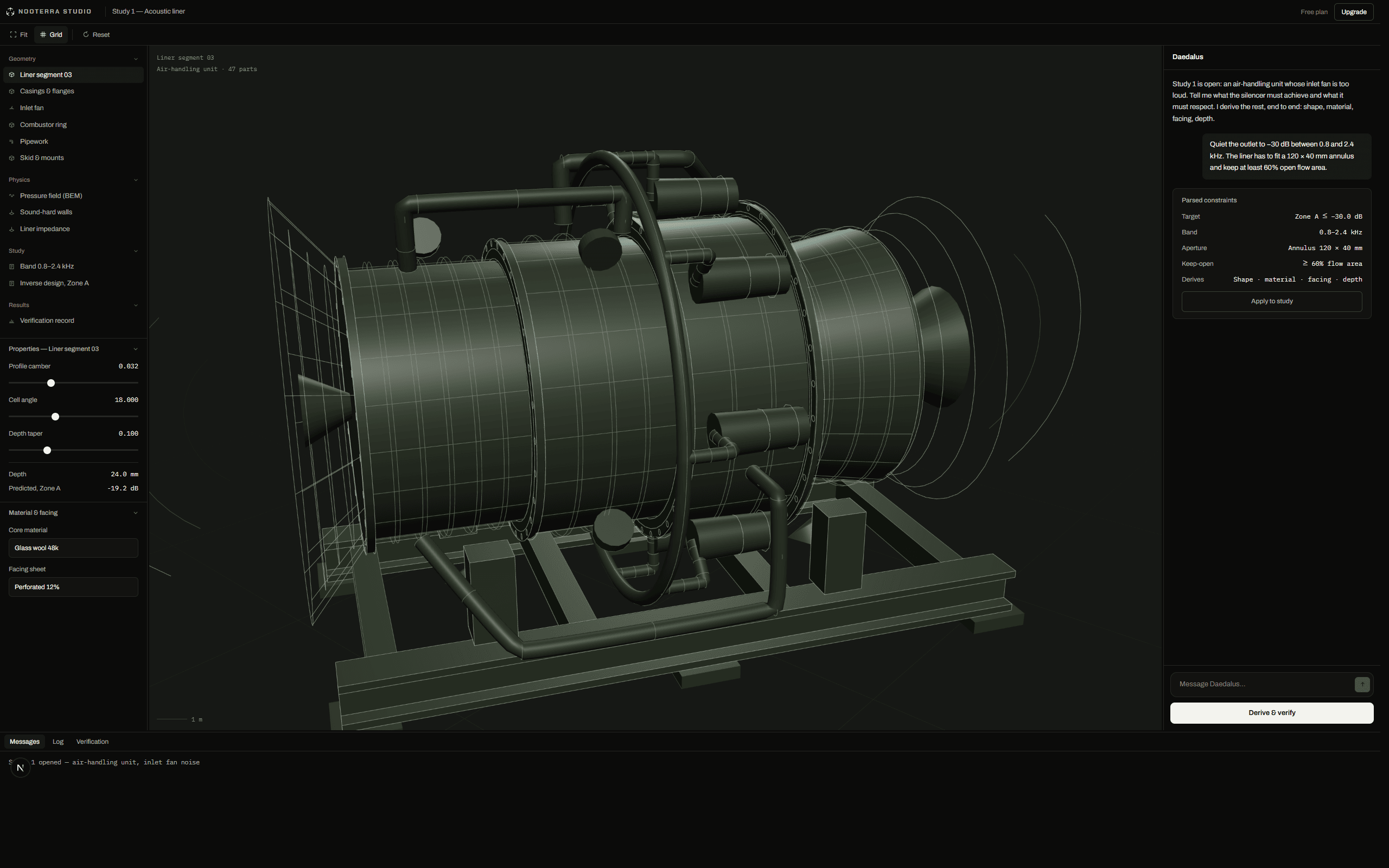
THE CURRENT BUILD, FULL VIEW. FREE TIER INCLUDES BROADBAND ACOUSTICS; MORE PHYSICS UNLOCKS BY PLAN AS EACH ENGINE SHIPS.